The experience that built your firm is the reason it can't grow
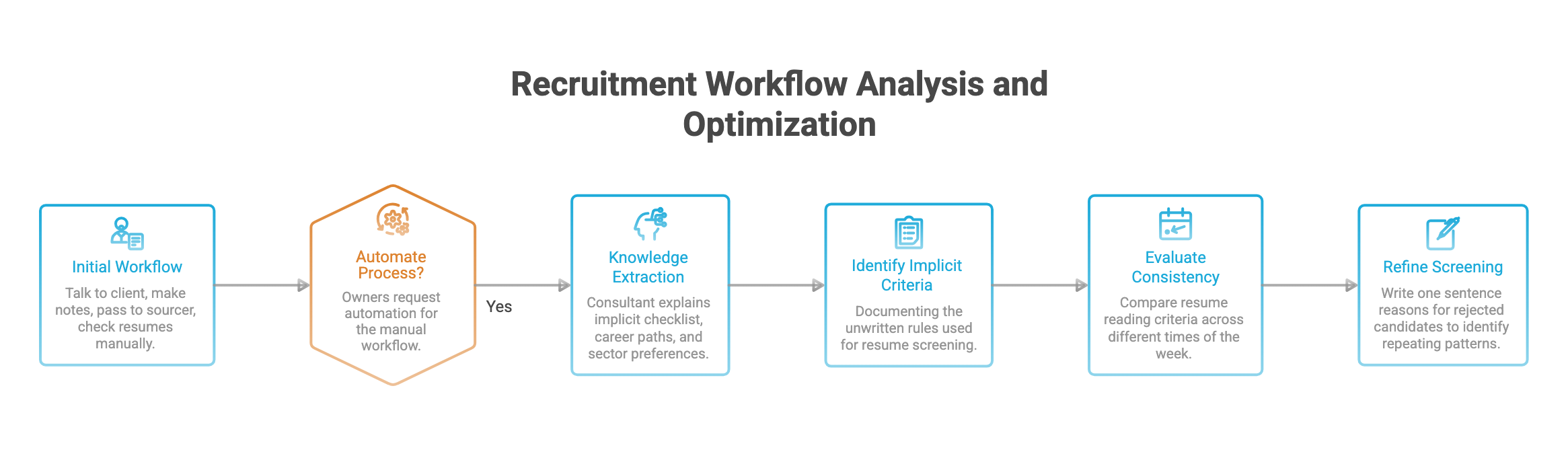
Owners tell me the same thing. They talk to the client, make their notes, pass the work to their sourcers, and check the resumes themselves when it comes back.
Then they ask me to automate it.
What they have not asked is why they are the only one who can do it.
I was working a search with a consultant who gave me everything. The job description, the hiring manager's notes, the company background, who they had hired before, access to the ATS. We met for over an hour. I sourced eleven candidates and set up a call to go through them.
She got to the first one and said, "Nope, this one's not good." Then the next one. So I stopped her and asked her to go back and tell me why.
She started working through a checklist that had never been written down. The career path, and where it went wrong. Which companies and sectors produce people who never translate well. She went on and on.
It was a gold mine that, until that morning, had never left her head.

The bottleneck is not experience. It is undocumented judgment.
That consultant was not being inconsistent. She was applying pattern recognition built over years of search work.
The problem was that nobody else could see the pattern, challenge it, improve it, or apply it at scale. It lived in her head, appeared in conversation, and disappeared again when the call ended.
That is where many firms stall.
They do not have a sourcing problem or an AI problem. They have a translation problem: turning the judgment that makes their work good into a repeatable way of working that other people and systems can learn from.
Start small:
Capture the reasons behind the last few “no” decisions, not just the decisions themselves.
Notice which criteria repeat across searches, clients, and roles.
Turn those patterns into a working rubric your team can test, refine, and eventually use to guide AI-assisted research.
You do not need to reduce expert judgment to a rigid checklist. You need to make it visible enough that it can be taught, stress-tested, and strengthened.
That is how experience becomes an asset for the firm, rather than a ceiling on its growth.
Here is the part owners miss. The way you read resumes on a Monday morning is not the way you read them at the end of a long week. Same person, same criteria, different output.
Try this in five minutes: take the last three candidates you passed on quickly and write one sentence on why for each. See how many reasons repeat.
Read the full story: what I built from that conversation, and what it means for your firm